Commercial Access Control
Access control decides who can open which door, and when. We install and service it on commercial, industrial, institutional and multi-residential buildings, from a single door to a whole building, on new systems and on ones someone else put in.
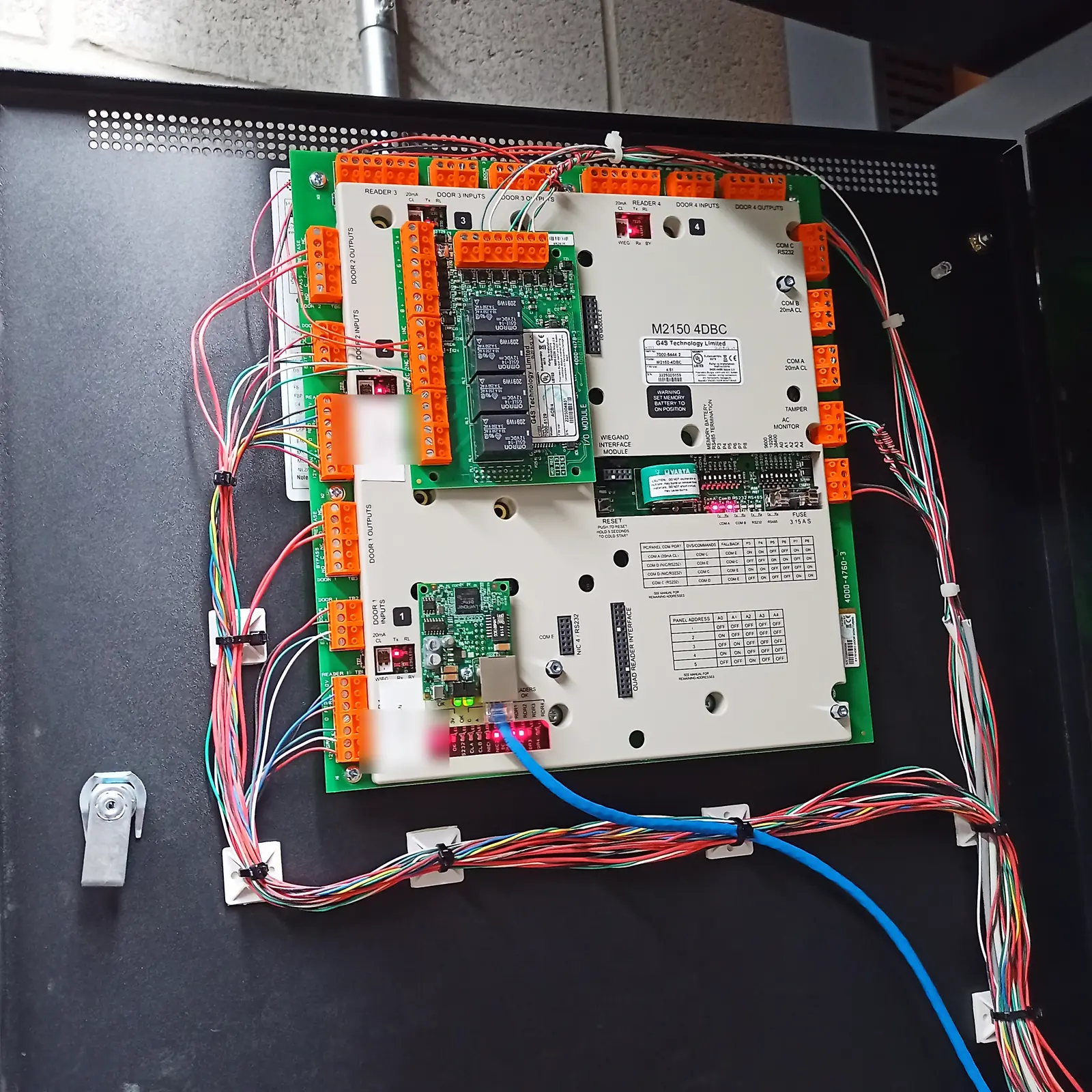
Scope of work
Each part of the system, and what we do on it.
| Part | What we do |
|---|---|
| Readers | Card, fob, mobile and keypad readers; fingerprint, face, voice and iris readers where a door needs a second factor |
| Controllers | Door controllers, panels and power supplies with battery backup, mounted, wired and labelled |
| Locking hardware | Electric strikes, storefront deadlatches, crash bars and exit devices, electrified mortise locks and maglocks |
| Door monitoring | Door contacts and request-to-exit sensors, so the system reports a door forced open or held open |
| Read-in / read-out | Readers on both sides of a door, so the system records who went in and who came out |
| Elevators | Floor control: a reader in the cab decides which floor buttons a credential can use |
| Gates and equipment | The same credentials on vehicle gates, pedestrian gates and controlled equipment |
| Fire release | Door release on a fire alarm signal, wired to the building's fire alarm interface |
| Programming | Credentials, access levels, schedules and holidays, set up and handed over with training |
The final scope follows the drawings, the site walk and what each trade supplies.
What sits behind one controlled door
The reader is the part people see, and the smallest part of the job. Behind it is the locking hardware on the door, a contact that knows whether the door is shut, a sensor that lets people out without a card, a power supply, a cable back to the controller, and the programming that ties it together.
Most problems on an access job start at the door itself: a frame never prepared for a strike, a door that doesn't close fully, or no pathway back to the panel. We check each door before we price it.
Fail-safe or fail-secure
A fail-safe lock unlocks when it loses power. A fail-secure lock stays locked. Which one a door needs depends on its role: an exit route has to let people out in an emergency, while a storage room usually stays locked. The fire release, the lock type and the exit hardware are chosen together, door by door.
Systems we work on
We install and program systems built on Mercury-based controllers, Avigilon, Lenel/S2, ICT, Axis and Brivo, and we take over mixed-brand sites. Office base-building access is often Mercury-based, Avigilon or Lenel/S2, and the building usually has a standard. For condo suites, ICT's addressed keypads on each riser give every unit its own partition.
- 1
- Power supply / sub-controller
- Class 2 power-limited supply, battery backup, fire-alarm relay interface for emergency egress release.
- 2
- Credential reader
- OSDP v2 over RS-485, encrypted. Smart card, NFC and BLE mobile credentials. Mounted within barrier-free reach range.
- 3
- Door position switch
- Concealed magnetic reed in the frame header. Reports whether the door is open or closed, and alarms when it is forced or held open.
- 4
- Request-to-exit sensor
- Shunts the door position alarm and releases the lock on approach, so egress never depends on a credential.
- 5
- Electric strike
- Fail-secure or fail-safe, field reversible, with diode suppression. Selected against the door’s life-safety role.
- 6
- Power transfer hinge
- Concealed transfer from frame to leaf, so an electrified lock body carries no exposed wiring.
Need access control work?
Tell us about the building and what you need. A few lines is enough; drawings can follow by email.